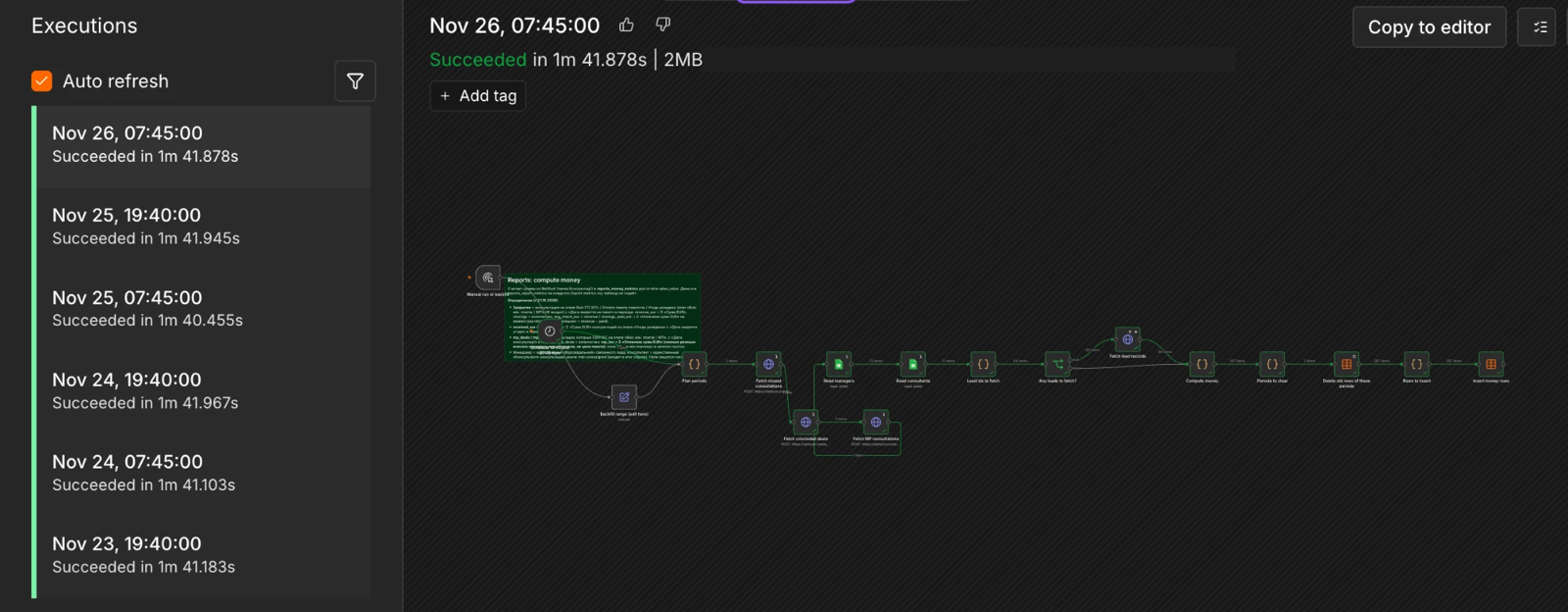
An education company sells its programmes through a sales team: lead, consultation, package payment. Team members used to write reports about this work by hand. The first request was simple: a daily Discord report that builds itself. Over time it grew into a full dashboard.
The project in brief
- Client: an education company, a sales team with lead-sorting managers and consultants. We do not name it.
- Systems: NetHunt (CRM), n8n, a dashboard inside the company’s internal platform.
- People: 23 people in the team at launch.
- Result: a daily routine of about 15 minutes per person is gone.
Before: reports by hand
At the end of the day everyone wrote a report: how many leads they took, how many they reached, who they passed on to a consultation. Roughly 15 minutes. There were also weekly and monthly reports, about 20 minutes each. The texts all looked different, so two people or two weeks could only be compared by eye.
Step one: reports in Discord
The first reports started working in September 2026. We began with the daily one and ended up automating daily and weekly reports on leads and on consultations. n8n pulls the records from NetHunt, calculates metrics per person and posts a short report to Discord in a format the team knows. Nobody has to write these reports by hand any more.
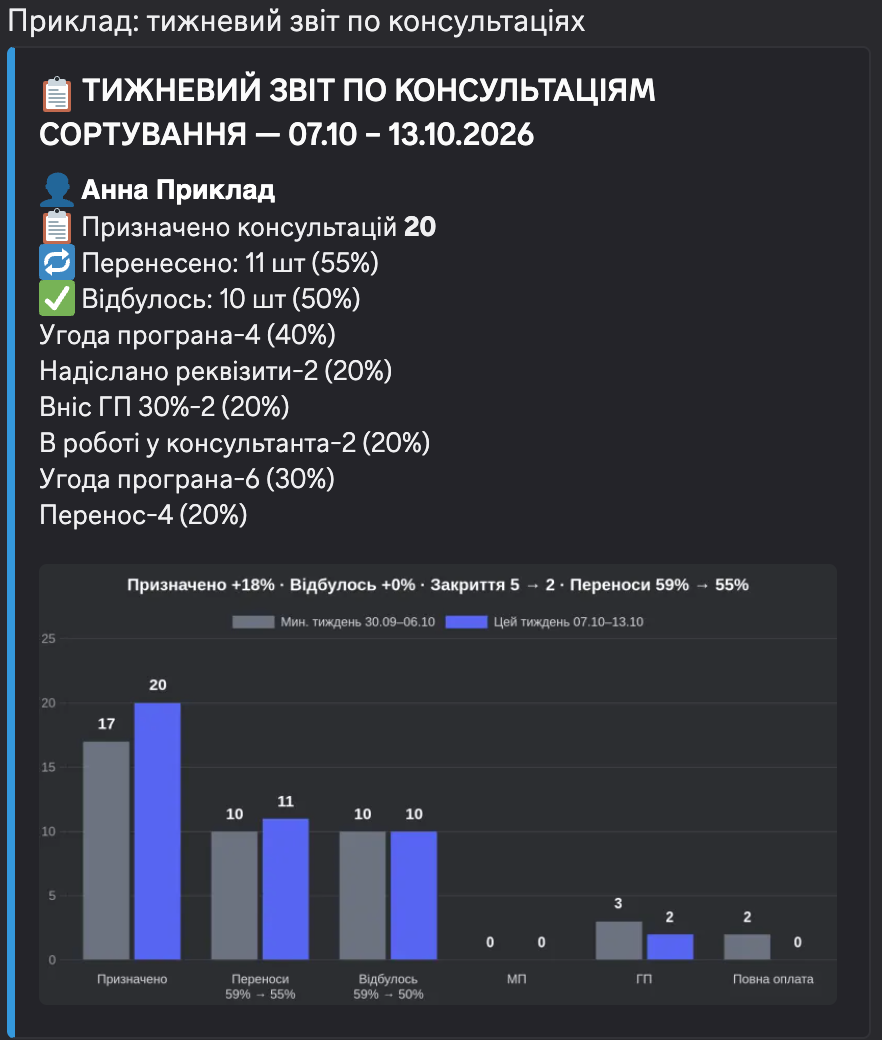
The weekly report in Discord (in Ukrainian). The name has been changed.
Step two: the dashboard
When we showed the client a test weekly report with charts, the idea came up to move everything into a separate dashboard. CRM data now reaches the company’s platform every day, and the manager sees:
- a funnel from lead to payment with conversion between stages;
- “Leads”, “Consultations” and “Finance” sections with a period selector (week or month in Finance) and comparison with the previous period;
- a table by person and by lead source that highlights weak spots, for example a share of rescheduled consultations above 35%;
- a checkbox selection of team members: compare two consultants or take a whole group;
- revenue and average order value in euros, shown separately. Not everyone has access to the amounts.
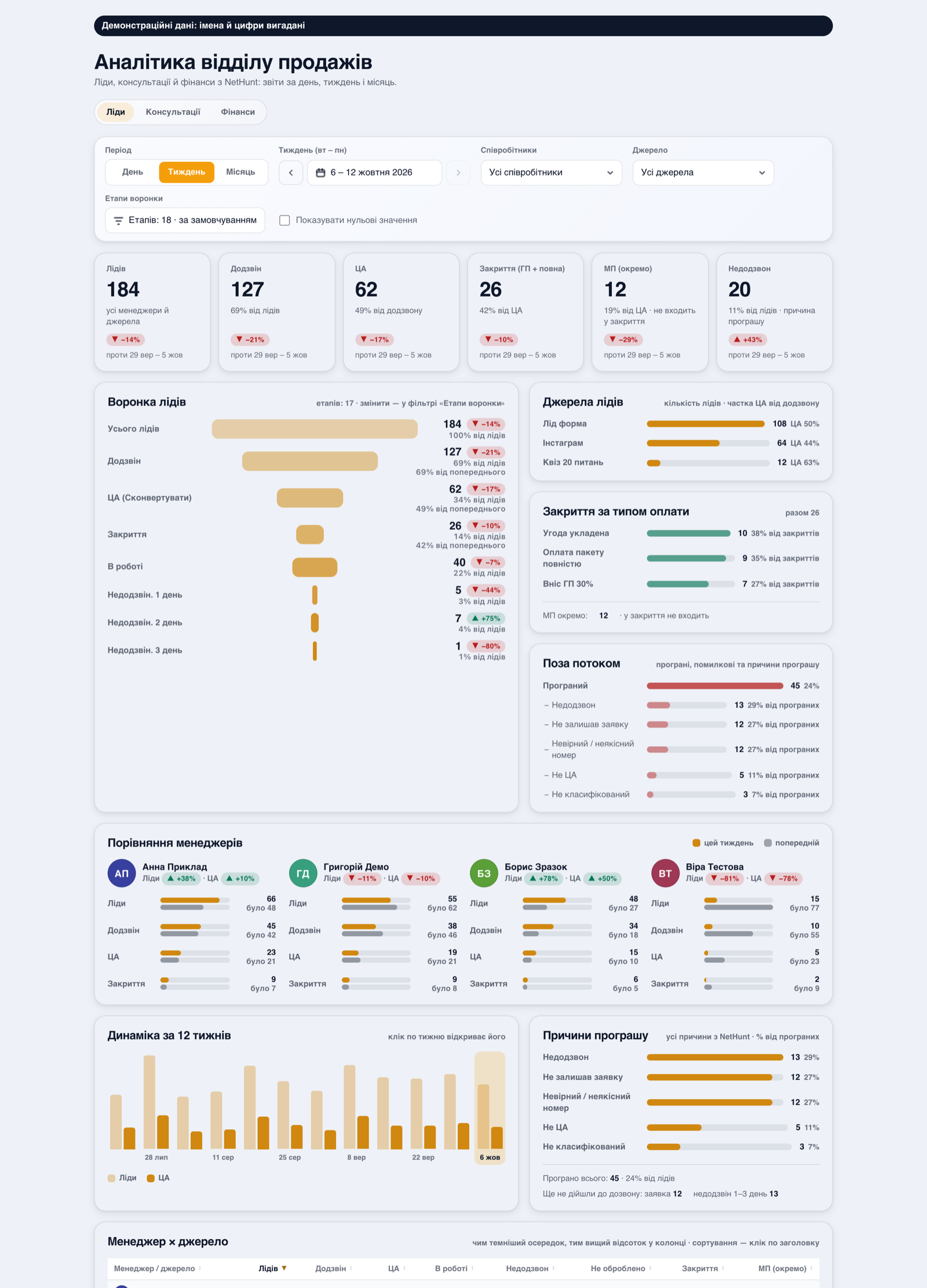
Weekly leads. The dashboard is shown with demo data.
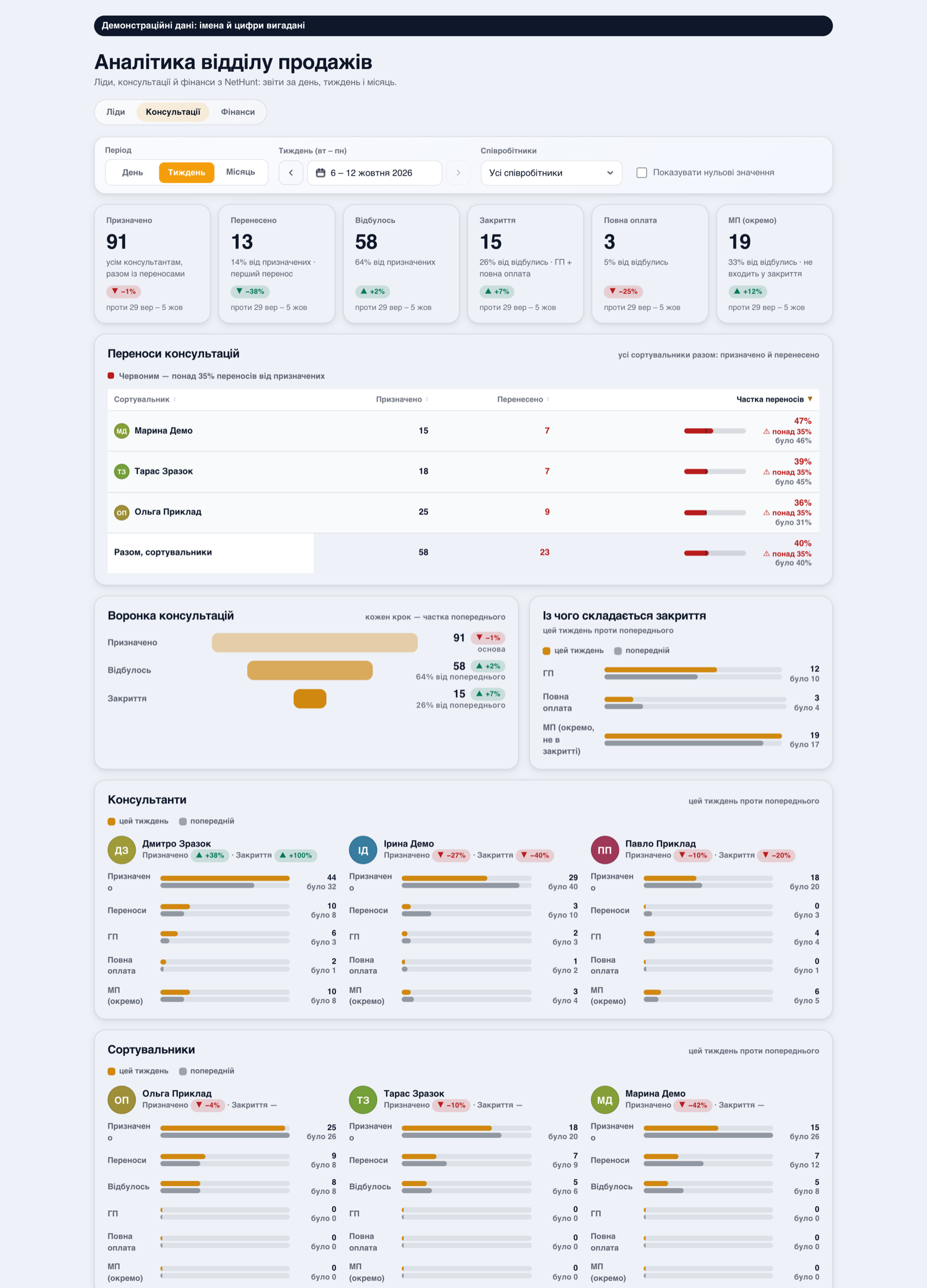
Consultations and reschedules. Demo data.
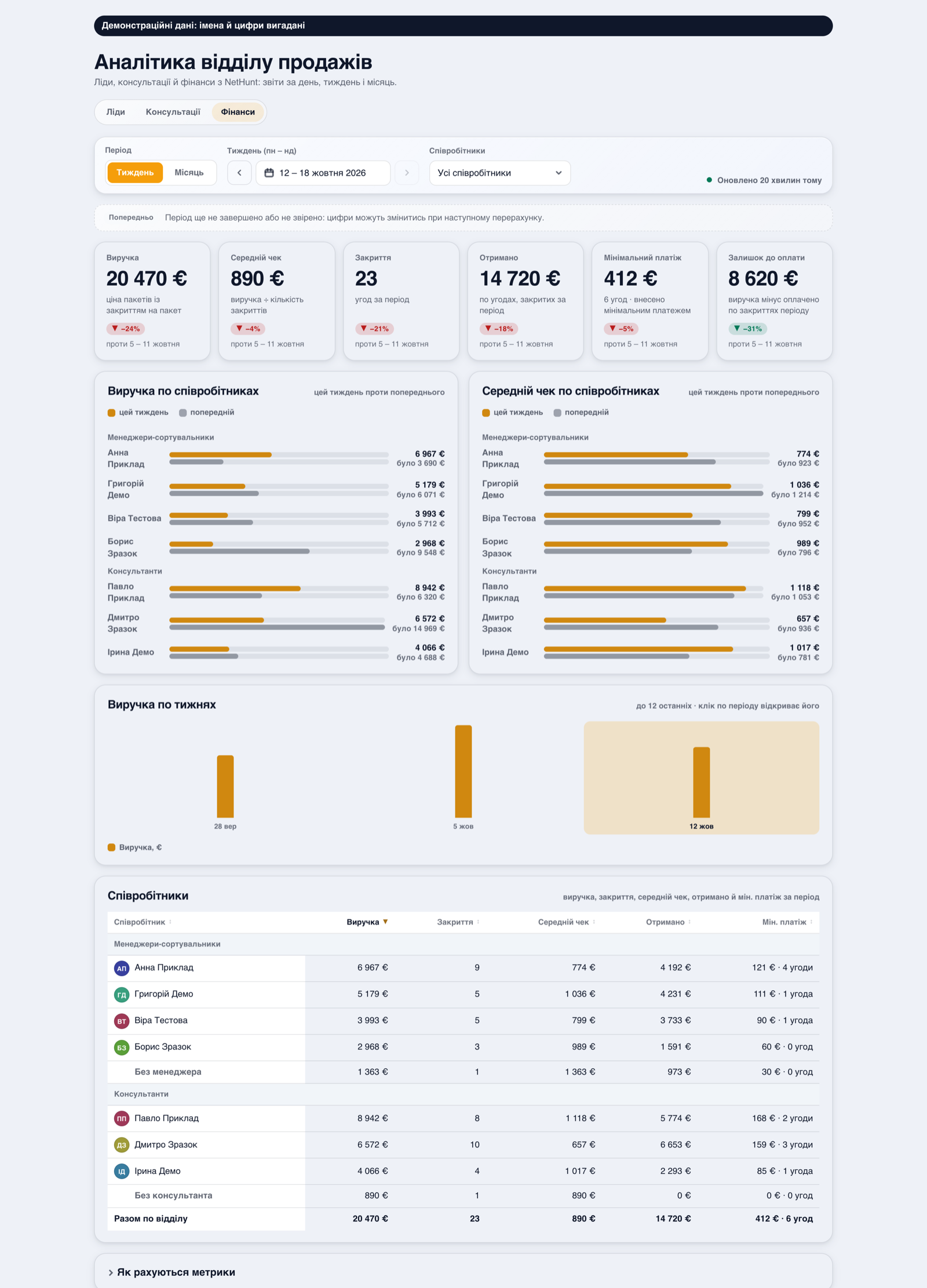
Finance. Demo data.
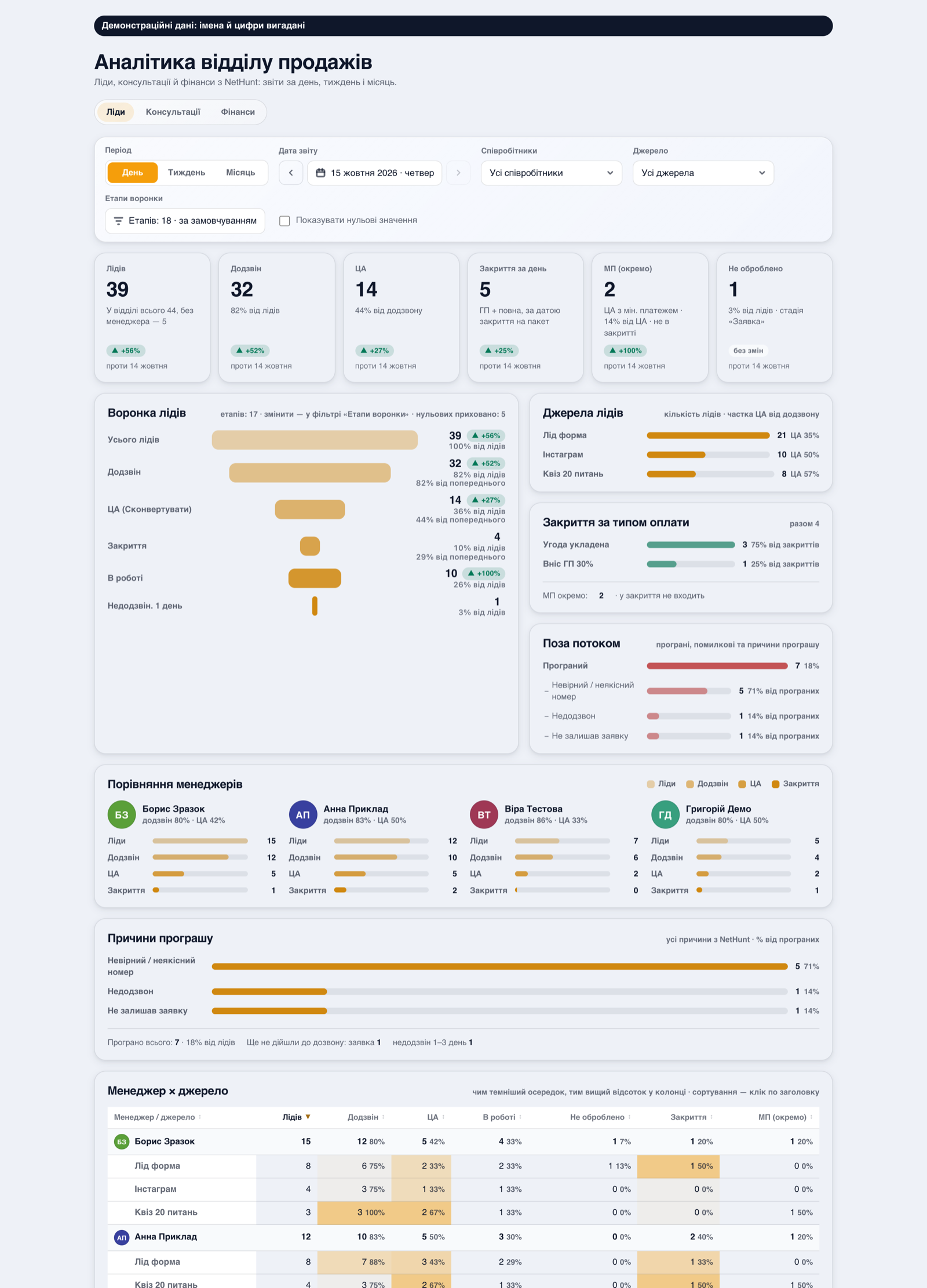
Daily leads. Demo data.
How it works
- Twice a day (morning and evening, Kyiv time) n8n pulls stage changes from the CRM and calculates the metrics. Evening calculations finish by 19:45, and a reconciliation runs in the morning.
- Results are stored in n8n data tables, from where a read-only channel picks them up. Once a day the platform syncs them into its own database. The page shows when the data was updated and warns if there has been no sync for a long time.
- Periods follow the way the company counts: the lead and consultation week runs Tuesday to Monday, the finance week Monday to Sunday, the month from the 6th to the 5th.
The main challenge: numbers as of the event, not as of today
If you calculate from a record’s current state, last week’s numbers change every time a manager moves a deal to another stage. So the calculation restores the history: who the consultant was at the time of the consultation and which stage the record was in on the day of the event. Yesterday’s report no longer changes today.
The second challenge: stages are named differently in different pipelines, so we had to agree separately on what counts as a “closing”. The minimum payment is now shown on its own and is not part of closings. The mismatch in closings between Discord and the dashboard has been removed.
What changed: a small routine that multiplies
15 minutes a day looks like a trifle. But every person spends them, every day. This is an estimate based on about 15 minutes per person.
- 1 person: 15 minutes a day.
- 23 people, as at launch: about 6 hours a day, or more than 120 hours a month (22 working days).
- 100 people: 1,500 minutes, which is 25 hours a day.
And that is only the daily reports, without weekly and monthly ones and without the manager’s time. The routine is gone, and the numbers now sit in one place in one format. How much extra revenue this brought cannot be estimated, and we do not claim it.
“Vania, thank you for all the goodies and the help! And for putting up with 150 thousand revisions”
From a message by a member of the client’s team (translated from Ukrainian)